 Back To Big Bend
Hiking And Backpacking
| Introduction | Big Bend National Park is a hiker's paradise containing the largest expanse of roadless public lands in Texas. More than 150 miles of trails offer opportunities for day hikes or backpacking trips. Elevations range from 1,800 feet at the eastern end of Boquillas Canyon to 7,825 feet atop Emory Peak in the Chisos Mountains. These elevation changes produce an exceptional variety of plants, animals, and scenic vistas. |
| The Backcountry | Chisos Mountains: Because they receive more
precipitation than the rest of the park, the Chisos are often referred to as a temperate
island in a desert sea. Since the Chisos are the most popular hiking area in Big Bend
National Park, designated campsites help reduce damage to this delicate environment. Desert: The scenery varies widely ranging from the Rio grande floodplain to arid badlands, to sotol grasslands, to rugged volcanic peaks. The desert provides virtually any backcountry experience sought by any hiker. Some areas are often used: others, more isolated, are seldom used and reflect a true wilderness setting. |
| Trails | About 30 miles of park trails are developed and heavily used. These include short nature trails and the trails in the Chisos Mountains. Most other trails are primitive, difficult to follow, and in some instances no more than a route up a dry wash. Due to the complex topography and vague trails, detailed 7.5 minute topographic maps and a compass are necessary for most hikes. All overnight backpackers must obtain a free Backcountry Use Permit. Permits are issued in person only on a first-come, first-served basis up to one day in advance of departure. Permits for the high Chisos designated campsites are available at the Chisos Basin Visitor Center. Maximum group size is 15. |
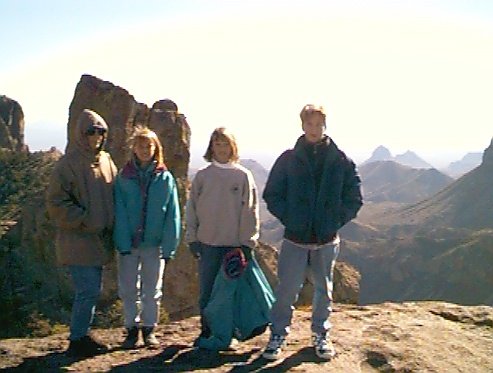
Our favorite hike was along the Lost Mine Trail. The view at the top speaks for itself...
Air quality is a problem at Big Bend, but on this day visibility was around 170 miles!