Los Alamos, city, seat of Los Alamos County, central New Mexico, on Pajarito Plateau overlooking the Rio Grande Valley; incorporated 1968. Principally a research center, the city is the site of Los Alamos National Laboratory. Los Alamos is also the site of a junior college, the Bradbury Science Museum, and the Fuller Lodge Art Center, which includes the Los Alamos Historical Museum, an arts center, and a performing arts facility. Bandelier National Monument and Jemez State Monument, both featuring Native American Pueblo ruins, are nearby. During World War II the site was chosen by the U.S. government for nuclear weapon research, and the first atomic bomb was developed here. The community subsequently was under the control of the Atomic Energy Commission from 1947 until 1962, when it became self-governing; during this period the first hydrogen bomb was designed here. The city's name is Spanish for "the poplars." Population (1980) 11,039; (1990) 11,455.
Los Alamos National Laboratory, research facility in Los Alamos, New Mexico, where the first atomic and hydrogen bombs were developed. The laboratory is funded by the United States Department of Energy and operated by the University of California. When it was founded in 1943, the laboratory was devoted solely to weapons development. It has since broadened its research to high-speed computing, advanced materials, lasers, environmental technologies, space sensors, and other fields.
Reviewed by: Los Alamos National Laboratory
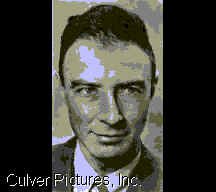
Oppenheimer, J. Robert (1904-1967), American physicist and government adviser, who directed the development of the first atomic bombs.
Oppenheimer was born in New York City on April 22, 1904, and was educated at Harvard University and the universities of Cambridge and Göttingen. After serving with the International Education Board (1928-1929), he became a professor of physics at the University of California and the California Institute of Technology (1929-1947), where he built up large schools of theoretical physics. He was noted for his contributions relating to the quantum theory, the theory of relativity, cosmic rays, positrons, and neutron stars.
During a leave of absence (1943-1945), Oppenheimer served as director of the atomic bomb project at Los Alamos, New Mexico. His leadership and organizational skills earned him the Presidential Medal of Merit in 1946. In 1947 he became director of the Institute for Advanced Studies in Princeton, New Jersey, serving there until the year before his death. He was also chairman of the General Advisory Committee of the Atomic Energy Commission, or AEC, from 1947 to 1952 and served thereafter as an adviser. In 1954, however, he was suspended from this position on charges that his past association with Communists and so-called fellow travelers made him a poor security risk. This action reflected the political atmosphere of the time, as well as the dislike of some politicians and military figures for Oppenheimer's opposition to development of the hydrogen bomb and his support of arms control; his loyalty was not really in doubt. Subsequently, efforts were made to clear his name, and in 1963 the AEC conferred on him its highest honor, the Enrico Fermi Award. Oppenheimer devoted his final years to study of the relationship between science and society; he died in Princeton on February 18, 1967. His writings include Science and the Common Understanding (1954) and Lectures on Electrodynamics (pub. posthumously 1970).
Source: Encarta 97